There is no single adhesive that is ideal for every project. The right choice depends on the surfaces being joined, the size of the area and the type of bond you need.
A glue stick may be all you need for paper and schoolwork. A liquid all-purpose adhesive is more flexible for mixed-material crafts. Wood requires a suitable wood adhesive, while spray adhesives can make larger flat surfaces easier to cover evenly.
The simplest rule is to choose the adhesive according to the material first and the application format second.
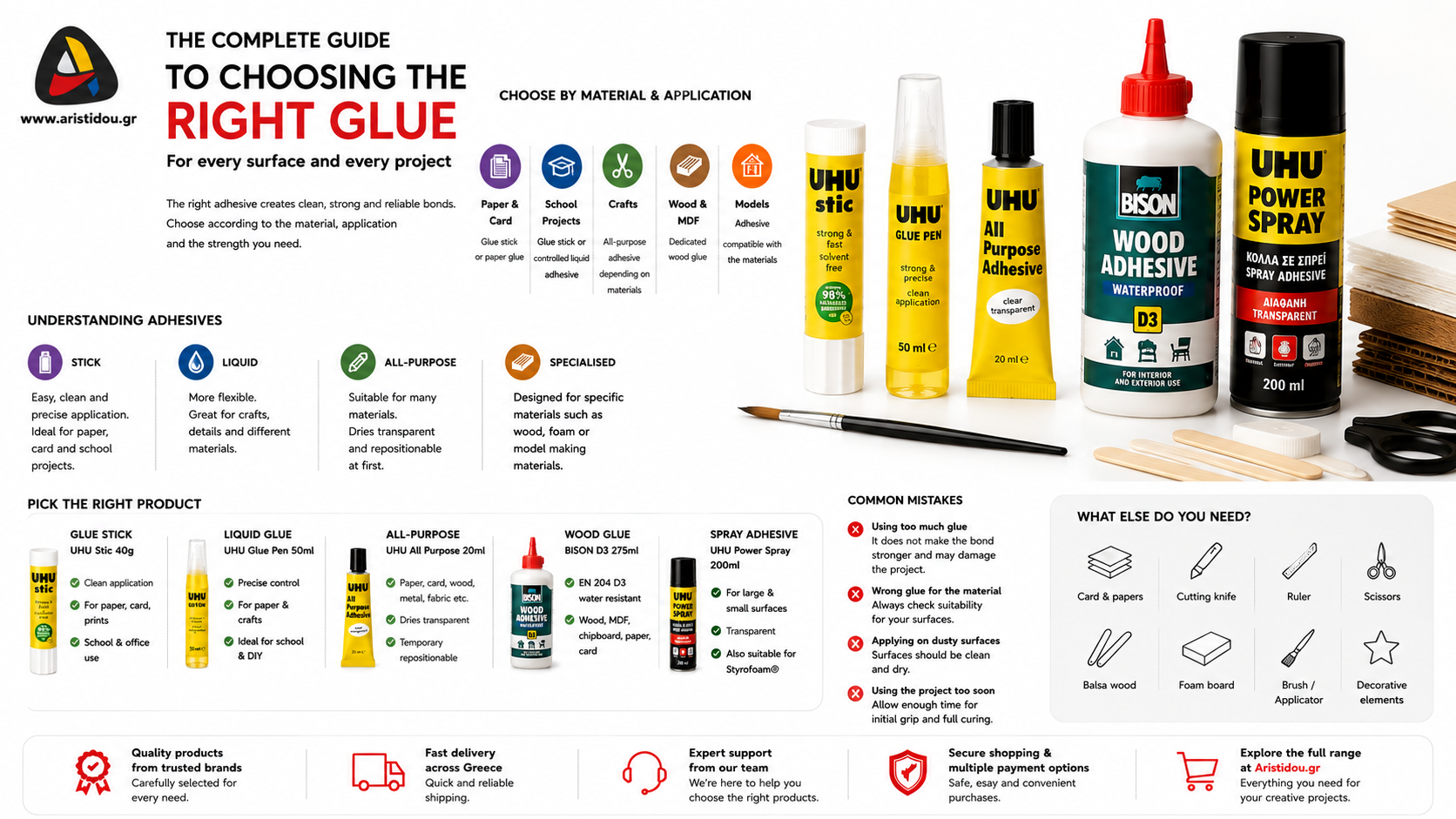 Which Glue Do You Need?
As a quick guide:
• Paper and card: glue stick or paper adhesive
• School projects: glue stick or controlled liquid adhesive
• Crafts: all-purpose adhesive, depending on the materials
• Wood and MDF: dedicated wood glue
• Models: an adhesive compatible with balsa, card, foam board or the specific construction material
• Large flat surfaces: spray adhesive when compatible with the surface
Always check the manufacturer's list of suitable materials before use.
Glue Sticks for Paper and Card
Glue sticks are a straightforward choice for paper-based projects.
They work particularly well for schoolwork, card, printed sheets, paper crafts and office tasks.
Their main advantage is control. They add very little moisture to the surface and are easy to apply without creating excessive mess.
UHU Stic 40g is designed for regular use with paper, card, school projects and crafts. The larger format is particularly useful when adhesive is used frequently.
Liquid Glue for Paper and Crafts
Liquid adhesives give you more flexibility when a project includes small details or several types of material.
The UHU Glue Pen 50ml is intended for paper and creative applications, with a pen-style format that helps control the amount applied.
Use only as much adhesive as the surface requires. Excess liquid can distort lightweight papers without necessarily creating a stronger bond.
When Is All-Purpose Glue Useful?
All-purpose adhesive is a practical option when a project combines several materials.
UHU All Purpose Adhesive 20ml is specified for paper, card, wood, metal, fabric and creative DIY work. It dries transparent and remains temporarily repositionable immediately after application.
This makes it useful for craft projects, school constructions, small models and decorative work.
An all-purpose adhesive does not, however, replace every specialist glue. A dedicated wood adhesive may be more appropriate for wooden joints, while some model-making materials require a compatible formula.
Which Glue Should You Use for Wood?
For wooden projects, use a dedicated wood adhesive.
The Aristidou.gr wood glue range includes different products for creative work, model making and more demanding wooden joints.
BISON PVAC Wood Adhesive D3 275ml is classified as water resistant according to EN 204 D3 and is designed for bonding wooden surfaces. The manufacturer also lists applications involving MDF, chipboard, paper and card.
Choose the product according to the actual project. A small craft made from wooden sticks does not necessarily require the same adhesive as a more demanding wooden construction.
Glue for Model Making
Model making often involves several very different materials, including balsa wood, model card, foam board, paper and plastic components.
For this reason, choose the adhesive after deciding which materials will actually be joined.
Balsa and wooden components may require a dedicated model-making or wood adhesive. With foam board, check compatibility carefully because some adhesive formulas can affect foam surfaces.
For architectural model making, it is worth selecting the adhesive at the same time as the board, foam and structural materials.
When Should You Use Spray Adhesive?
Spray adhesives are useful when a larger area needs an even layer of adhesive.
Depending on the product, they may be suitable for paper, card, fabrics, foam materials, mounting and creative projects.
UHU Power Spray 200ml is a transparent contact spray adhesive for small and large surfaces and is also specified as suitable for Styrofoam®.
Aristidou.gr also carries spray adhesives from brands including Bison, 3M and Cosmos Lac.
Use spray adhesives in a well-ventilated area and follow the manufacturer's instructions.
Common Adhesive Mistakes
Applying Too Much
More adhesive does not automatically create a stronger bond. On paper, excess liquid may cause buckling and can increase drying time.
Choosing by Format Rather Than Material
A convenient applicator does not make an adhesive suitable for every surface. Check material compatibility first.
Working on Dusty Surfaces
Bonding surfaces generally need to be clean and dry for proper contact.
Using the Project Too Soon
Initial grip and full curing time are not the same. Follow the drying and curing instructions provided with the adhesive.
Useful Materials to Add to Your Project
Depending on the project, you may also need card, specialist papers, foam board, balsa wood, craft sticks, a cutting knife, cutting mat, ruler or scissors.
For model making and crafts, choosing the adhesive together with the main construction materials helps avoid compatibility problems.
Conclusion
Choose glue according to the surfaces you are joining.
A glue stick is a practical option for paper and schoolwork. An all-purpose adhesive can handle many mixed-material craft projects. Wood needs an appropriate wood glue, while a compatible spray adhesive can be useful for larger areas.
Aristidou.gr offers adhesives for school, office, crafts, wood, model making and specialist applications.
Frequently Asked Questions
Which glue is best for paper?
A glue stick is a simple and controlled choice for most paper and card projects.
Which glue should I use for wood?
Choose a dedicated wood adhesive and check whether your project requires a particular level of moisture resistance.
Can one glue be used for every material?
Not always. All-purpose adhesives cover many common materials, but wood, foam board and specialist surfaces may require a different product.
When should I use spray adhesive?
Spray adhesive is useful for even coverage across larger surfaces, provided the adhesive is compatible with the material.