Buying drawing equipment for an Architecture, Civil Engineering or technical drawing course can quickly become more complicated than expected.
The best approach is to start with the requirements of the individual module. A drawing board, rulers, set squares, scale ruler, compass, pencils, drawing paper and technical pens may all be required, but not every student needs every item.
Always check the official materials list supplied by your lecturer before buying specialist equipment.
Browse technical drawing instruments at Aristidou.gr
 The Essential Checklist
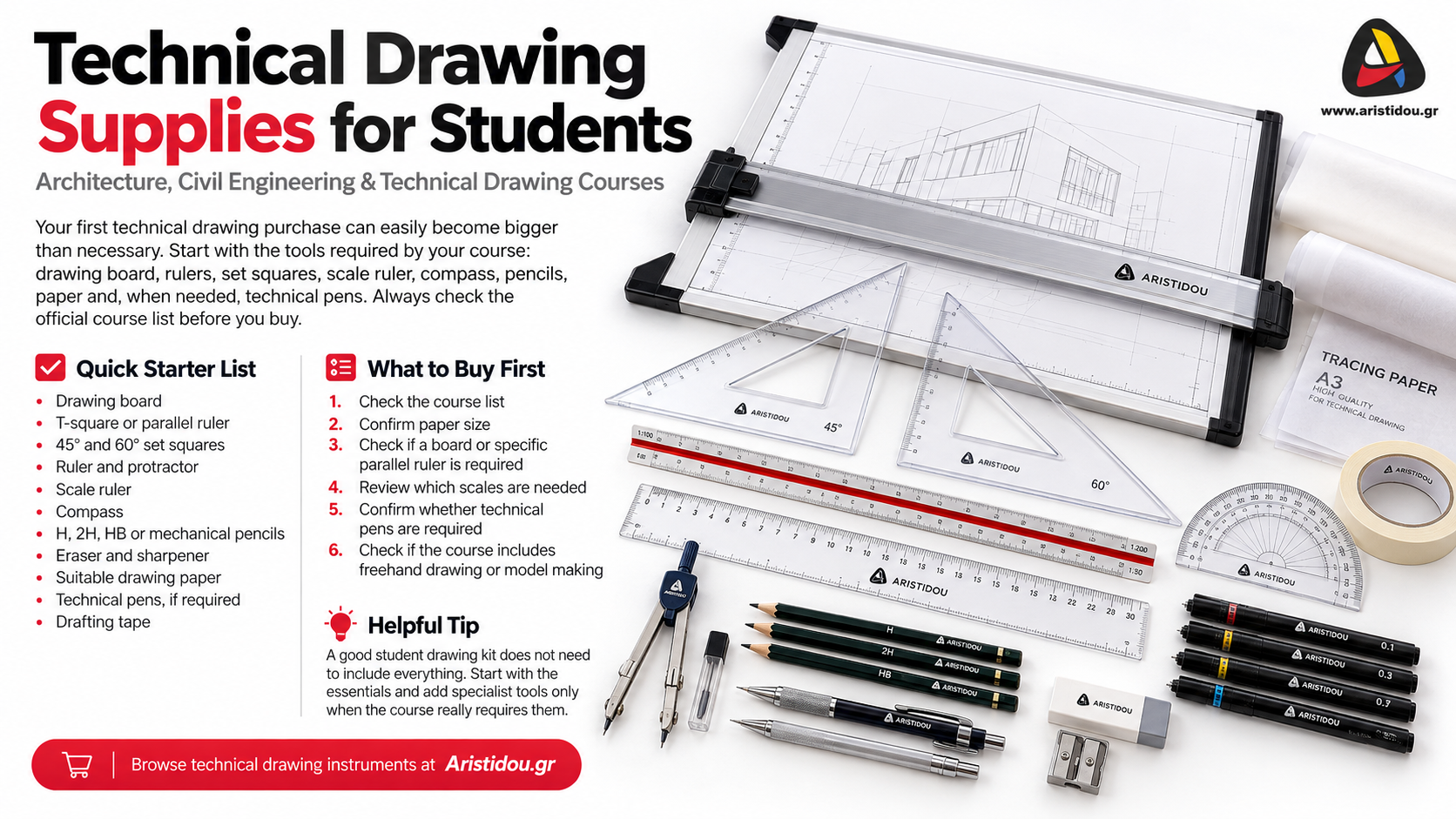
A basic technical drawing setup may include:
• drawing board
• T-square or parallel ruler
• 45° and 60° set squares
• ruler and protractor
• scale ruler
• compass
• H, 2H and HB pencils or mechanical pencils
• eraser and sharpener
• suitable drawing paper
• technical pens when required
• drafting tape
Treat this as a starting point rather than a universal university list.
Drawing Board, T-Square and Parallel Ruler
Manual technical drawing requires a stable working surface and reliable guidance for straight and parallel lines.
A technical drawing board provides a firm surface and can be combined with a T-square or parallel ruler.
The Drawing Boards, T-Squares & Parallel Rulers category includes different options for architectural and engineering drafting.
Check the required paper size before choosing your board, as larger sheets need a suitably sized working area.
Set Squares, Compasses and Scale Rulers
These are core precision tools for many technical drawing exercises.
Set squares help construct accurate angles and parallel lines. A compass is used for circles and geometric constructions, while a scale ruler allows dimensions to be read and transferred at different scales.
The Aristo Scale Ruler 1:20 to 1:125 combines several commonly used scales.
For geometric and angular work, the Rotring Centro Geodetic Triangle 23cm is designed for technical drawing.
When controlled curves are needed, the ARDA 29012 French Curve Set provides three curve templates.
Which Pencils Do You Need?
Clean, controlled lines matter in technical drawing.
Harder grades such as H and 2H are useful for light construction lines, while HB is more versatile for general drawing. The exact grade depends on the exercise and the lecturer's requirements.
For a clearer explanation of pencil grades, read Faber-Castell Drawing Pencils: H, HB, F and B.
Some courses may also require 0.5mm or 0.7mm mechanical pencils or 2mm lead holders. Avoid buying several systems until you know which one you will actually use.
Choosing Paper for Technical Drawing
Paper should be selected according to the drawing tool.
Pencil work requires an appropriate drawing surface, while technical pens and ink benefit from a smoother paper that allows precise lines.
Schoeller Glatt Drawing Paper has a smooth surface intended for technical drawing, ink and rapidograph pens.
The broader Drawing Papers range also includes matt drawing paper, tracing paper and several sheet sizes.
When Are Technical Pens Needed?
Technical pens are used when a drawing requires controlled and consistent ink line widths.
Different nib sizes help establish line hierarchy in technical and architectural drawings.
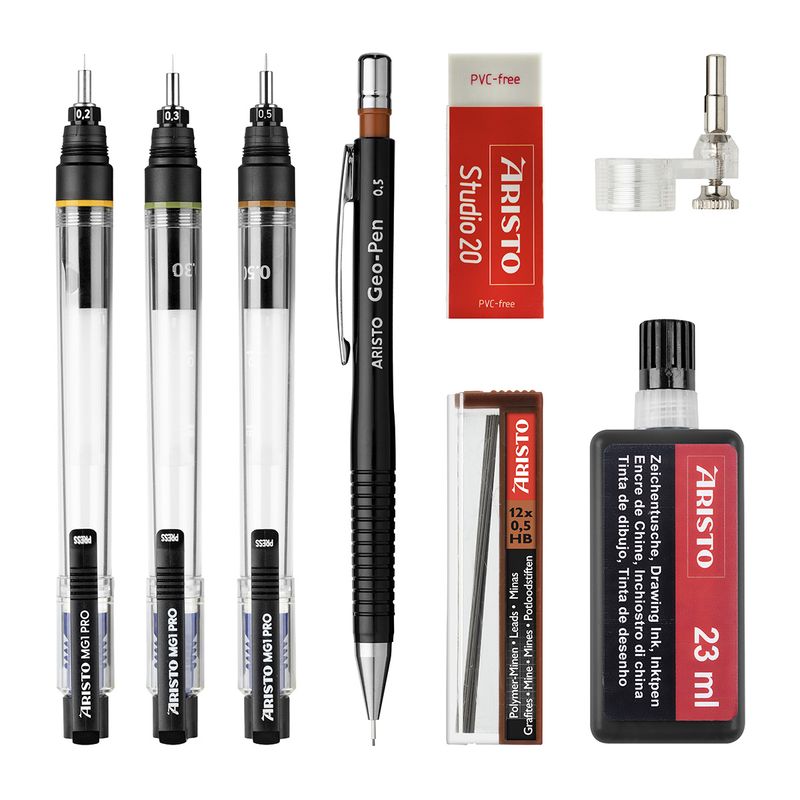
The Aristo MG1 PRO 0.20, 0.40 and 0.60mm Set provides three line widths in one set.
However, do not buy technical pens automatically. First confirm that your module requires ink drafting.
Browse the full Technical Pens & Rapidographs range.
Do Architecture and Civil Engineering Students Need the Same Supplies?
There is considerable overlap in basic drafting equipment, but individual course requirements vary.
Architecture modules may add freehand drawing, presentation and model-making materials. Civil Engineering modules may place more emphasis on technical drawings, scales, geometric construction and construction-related drafting.
The Civil Engineering Drawing Materials Set combines a drawing board, parallel ruler, paper, compass, mechanical pencil, leads, French curve, geodetic triangle and other drafting essentials.
The Engineering Drawing Materials Set is another practical option for technical drawing.
If your lecturer provides a highly specific list, the Custom Drawing Materials Package allows the equipment to be organised around individual academic requirements.
What Should You Buy First?
Before ordering, check:
- the official module list
- required paper sizes
- whether a drawing board or parallel ruler is needed
- the drawing scales you will use
- whether technical pens are required
- whether the course also includes freehand drawing or model making
This helps avoid duplicate purchases and keeps your first drawing kit focused on the work you will actually be doing.
Conclusion
A student drawing kit does not need to contain every drafting tool available.
Start with your course requirements and build around the essentials: a drawing surface, measuring instruments, pencils, suitable paper and any specialist tools specifically requested.
For a convenient starting point, Drawing Materials Sets for Students can bring several common essentials together in one purchase.
Frequently Asked Questions
What does a first-year Architecture student need?
Requirements vary by module. Wait for the official materials list before investing in specialist drawing boards, papers or technical pens.
What does a Civil Engineering student need for technical drawing?
Common equipment includes a drawing board, set squares, rulers, scale ruler, compass, pencils and suitable paper, depending on the course.
Do students need technical pens from the beginning?
Not necessarily. Buy them only if your module requires ink drafting with controlled line widths.
Is a ready-made drawing set worth buying?
Yes, when the contents match your course list. If your requirements are more specific, individual tools or a custom package may be more suitable.